Marketing Sourced Pipeline
Every quarter, marketing reports a sourced-pipeline number to the board, and the definition behind it goes unspoken. The CFO is skeptical for a reason: your marketing automation's default and your CRM's default disagree, the number swings depending on which one you used, and nobody can say which is right.
What this skill answers
The dashboard shows the same set of deals under three defensible definitions of "sourced," side by side:
- Lead-source — the deal's recorded lead-source value is one you confirmed as marketing.
- First touch — marketing produced the originating touch on the deal.
- Pre-sales — a marketing touch landed before sales' first activity on the account.
The gap between the three is the number worth knowing. You pick the one you're willing to defend and lock it. This is a definition comparison, not an attribution model: it makes the choice explicit instead of telling you which one is right.
What you'll see
A dashboard with two parts, built in about 15 minutes:
- The three definitions, side by side, with the gap between them called out and a Pick one to lock action that commits your choice for reporting.
- The deals behind it — an audit table, one row per opportunity, showing which of the three definitions it qualifies under, so any percentage traces straight back to the deals.
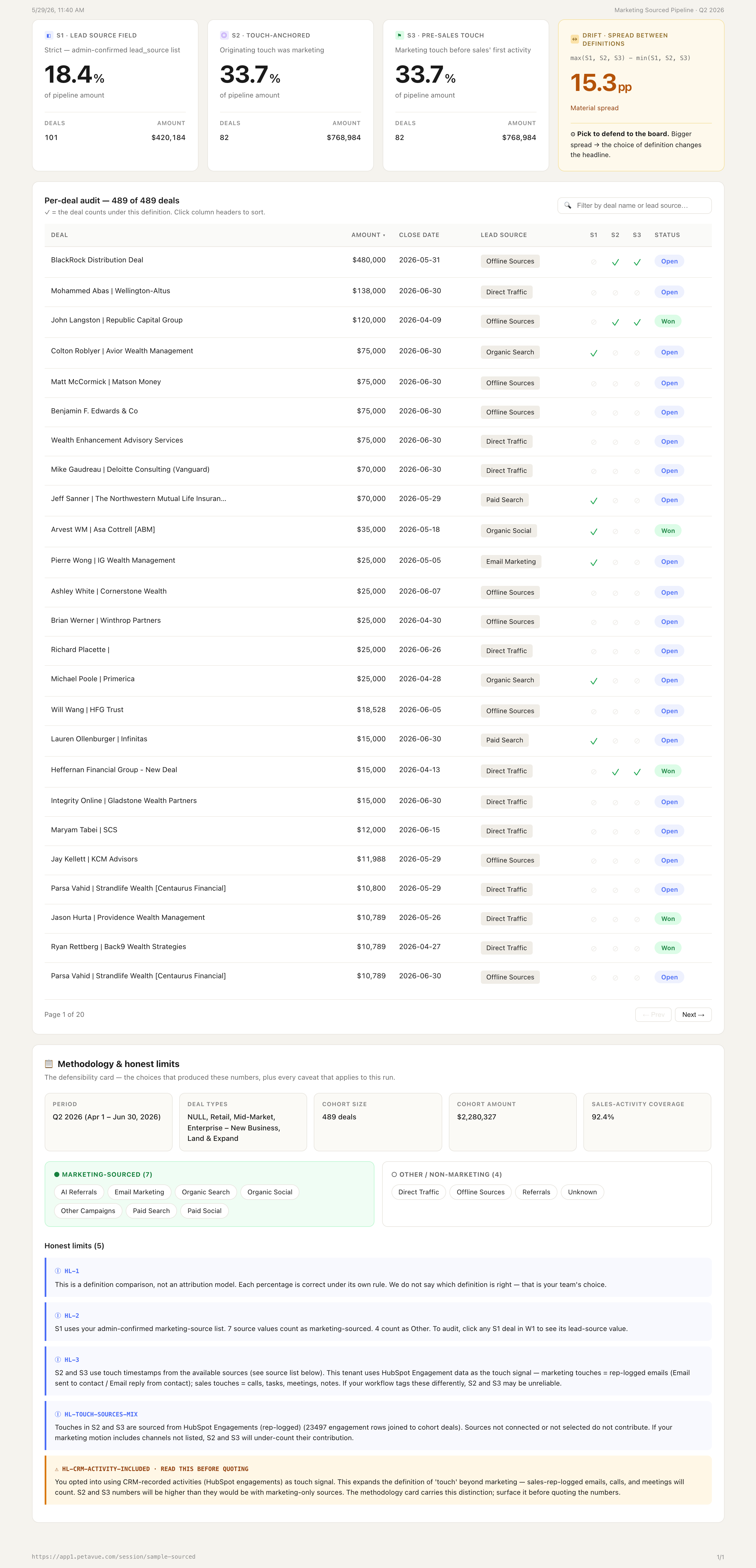
Once it's live, it answers in one traceable place: your sourced percentage under each definition, the size of the gap between the loosest and the strictest, which one you're locking, and which deals count under the definition you picked.
Before you run it
Required:
- A CRM (Salesforce or HubSpot) with opportunity records and a lead-source field
- Marketing automation (HubSpot) feeding marketing touches
Recommended:
- Ad platforms (Google, LinkedIn, Meta) and sales engagement (Salesloft, Outreach), which deepen the touch graph
The lead-source definition needs your lead-source field populated; the pre-sales definition needs sales activity tagged. Where either is thin, that column shows a dash and the other two still render. If a required source isn't connected, the agent stops before running and names it. See CRM Integrations for setup.
What the agent asks you
Two questions. Nothing runs until you confirm.
| Question | Why it matters | Default |
|---|---|---|
| Which sources count as marketing-sourced? | Sets the lead-source definition — the consequential answer | The agent prefills two groups by matching your lead-source values; you review and confirm rather than build from scratch |
| Which period should we analyze? | Sets the cohort | Current fiscal quarter |
Take the extra minute on the source grouping the first time. The agent saves it, so the next run starts from your confirmed list.
How to read the result
The three numbers tell three versions of the same quarter:
- Lead-source is only as good as your lead-source hygiene. It's whatever your CRM recorded as origin.
- First touch credits marketing when it produced the deal's originating touch.
- Pre-sales is the most disciplined: marketing got there before sales engaged at all.
The gap between them is the real signal. A wide gap means the definition you pick changes your board number materially, so pick deliberately. A narrow gap means your data tells a consistent story whichever you choose.
The audit table shows which definitions include each deal. Deals that qualify under all three are unambiguous marketing-sourced wins. Deals that qualify under only one are the contested ones, worth a per-deal look before you commit.
Known limits you'll see:
"You picked [Pre-sales]. The other two definitions would have produced [Lead-source: X%] and [First touch: Y%]. Surface the picked definition in any board narrative." Surfaces after you lock a choice.
"Only [N]% of your touches are tagged with a touch_system. The definitions depend on this tagging, so coverage gaps reduce reliability." Surfaces when touch tagging is thin.
What this skill doesn't do
- Pipeline marketing touched but didn't originate? → Marketing Influenced Pipeline
- Revenue credit across channels? → Multi-touch Revenue Attribution
- Enough pipeline to hit the quarter? → Pipeline Coverage